



In today’s digital era, streamlining finance operations has become crucial for small and medium-sized businesses. Bill.com is a fintech platform designed to automate accounts payable (AP) and accounts receivable (AR) processes, helping businesses manage invoices and payments efficiently. Its main goal is to replace manual bookkeeping and traditional payment processes with a centralized, automated system, allowing accounting and finance teams to focus on strategic, value-added tasks.
- History and Background of Bill.com
- Core Features of Bill.com
- Benefits of Using Bill.com
- Challenges and Cons of Bill.com
- Who Should Use Bill.com?
- Getting Started with Bill.com
- Alternatives and Comparisons
- Future Trends and the Outlook for Bill.com
- FAQs
- Q1: What is Bill.com?
- Q2: How does Bill.com work?
- Q3: What are the benefits of Bill.com?
- Q4: Is Bill.com suitable for small businesses?
- Q5: What are some alternatives to Bill.com?
- Conclusion
For companies still relying on paper invoices or spreadsheets, Bill.com offers a comprehensive solution that improves efficiency, reduces costs, and enhances cash flow. This guide explores Bill.com’s features, benefits, challenges, implementation tips, alternatives, and future trends, giving readers a complete overview of this powerful platform.
History and Background of Bill.com
Bill.com was founded in 2006 by René Lacerte under the name “Cashboard, Inc.” Initially, it provided a simple bill payment solution for small businesses. Over time, it evolved into a complete financial operations platform. Around 2010, the platform introduced cloud-based automation and seamless integration, simplifying complex workflows for accounting and finance teams. In 2019, Bill.com went public, cementing its position in the fintech industry.
Today, it is a recognized name globally, helping businesses modernize their financial processes. René Lacerte’s vision of replacing manual processes with digital automation continues to be reflected in the platform’s core features.
Core Features of Bill.com
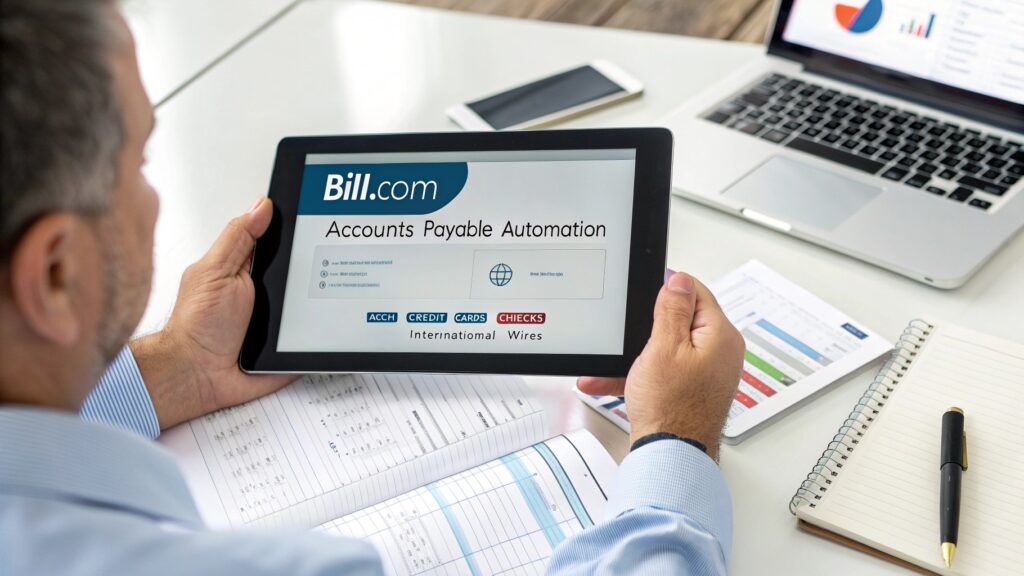
One of Bill.com’s most popular features is accounts payable automation. It allows businesses to capture invoices, manage approvals, and process payments efficiently, whether invoices arrive via email, scan, or upload. Multi-step approval workflows and custom policies ensure that every payment is secure and accurate. Businesses can process ACH, credit card, checks, and international wire payments through the platform. Bill.com maintains a complete audit trail for every transaction, which is essential for compliance and fraud prevention.
Another significant feature is accounts receivable and invoicing. This feature enables businesses to create professional, branded invoices, set up recurring invoices, and send automated payment reminders. It also allows users to track customer payments, ensuring timely collections and improving cash flow.
Invoice financing is another key offering. Businesses can receive an advance on unpaid invoices to meet immediate cash flow needs. The platform provides transparent fee structures and fast processing, which is especially useful for companies seeking predictable liquidity.
Bill.com’s integrated financial operations platform offers even greater efficiency. Businesses can manage AP, AR, and expenses from a single dashboard. The platform seamlessly integrates with major accounting software like QuickBooks, Xero, and Sage, making data synchronization and reporting simple. Artificial intelligence and automation tools capture invoice data, detect duplicates, and enable predictive workflows, enhancing efficiency and decision-making.
Benefits of Using Bill.com
The primary benefit of Bill.com is efficiency. By automating manual tasks and traditional payment processes, businesses significantly reduce the time and effort spent on routine finance operations. This allows finance teams to focus on strategic, high-value activities. Cash flow management is another key advantage, with faster accounts receivable processing and optimized accounts payable scheduling.
The platform also reduces costs and minimizes errors by replacing paper checks with digital payments. Scalability is an added benefit, as multi-entity businesses can manage multiple departments and workflows from a centralized system. Overall, Bill.com modernizes financial operations, improving both productivity and profitability.
Challenges and Cons of Bill.com

Despite its advantages, Bill.com has some challenges that businesses should consider. Some users report issues with customer support, citing slow response times or unhelpful guidance. The account verification process can be strict, often requiring sensitive documents like bank statements and personal identification.
Some small businesses have reported account suspension or closure without clear reasons. Additionally, the platform’s cost structure—including subscription fees and transaction fees—can be significant for high-volume businesses. Therefore, understanding these potential challenges before adoption is essential.
Who Should Use Bill.com?
Bill.com is ideal for small and medium-sized businesses looking to automate their invoice and payment processes. Accounting firms managing multiple clients can also benefit from the platform.
Companies seeking predictable cash flow or invoice financing find its features particularly valuable. Additionally, businesses that require seamless integration with accounting software will find Bill.com an excellent fit for streamlining operations and improving efficiency.
Getting Started with Bill.com
Starting with Bill.com is straightforward. It is recommended to begin with a demo or trial account to explore the platform’s features and interface. Integrating the platform with existing accounting software is essential to synchronize all financial data automatically. Approval workflows should be customized to specify who approves invoices and in what sequence.
Training team members is also crucial to fully utilize automation and AI tools. Businesses using invoice financing should carefully review eligibility requirements and fee structures to avoid unnecessary costs.
Alternatives and Comparisons
Other invoicing and payment platforms include QuickBooks Payments, FreshBooks, and Zoho Invoice. However, Bill.com’s unique advantage lies in its ability to manage entire AP and AR workflows from a centralized platform.
While QuickBooks and FreshBooks primarily focus on accounting or invoicing, Bill.com offers a comprehensive solution that integrates automation and workflow management, making it a more complete financial operations tool for growing businesses.
Future Trends and the Outlook for Bill.com
The role of AI and automation in fintech is increasing, and Bill.com is well-aligned with these trends. AI tools facilitate invoice capture, approval workflows, and predictive insights, reducing human error and increasing efficiency. The platform is also expanding globally, offering international payment solutions for multinational businesses.
Embedded finance and partnerships with banks are part of Bill.com’s future strategy, allowing financial institutions to provide services directly to its users. Security and fraud prevention will remain a priority, maintaining user trust and compliance as the platform grows.
FAQs
Q1: What is Bill.com?
Bill.com is a cloud-based platform that automates accounts payable and accounts receivable, helping businesses manage invoices and payments efficiently.
Q2: How does Bill.com work?
It captures invoices, automates approvals, and processes payments via multiple methods, including ACH, credit cards, checks, and wires.
Q3: What are the benefits of Bill.com?
Bill.com improves efficiency, cash flow, cost reduction, error prevention, and scalability for businesses.
Q4: Is Bill.com suitable for small businesses?
Yes, it is ideal for small and medium businesses looking to modernize and automate finance operations.
Q5: What are some alternatives to Bill.com?
QuickBooks Payments, FreshBooks, and Zoho Invoice are popular alternatives, though Bill.com offers a more comprehensive AP and AR solution.
Conclusion
Bill.com is a modern and comprehensive platform that streamlines and automates business financial operations. Its features, such as accounts payable automation, accounts receivable management, invoice financing, and AI-driven workflow optimization, help improve efficiency and cash flow. While subscription and transaction costs should be considered, the platform proves highly valuable for small and medium-sized businesses. For companies looking to modernize their finance processes and reduce errors, Bill.com is a reliable and scalable solution that can take business operations to the next level.
Related posts: